Great service, fast delivery, great device!
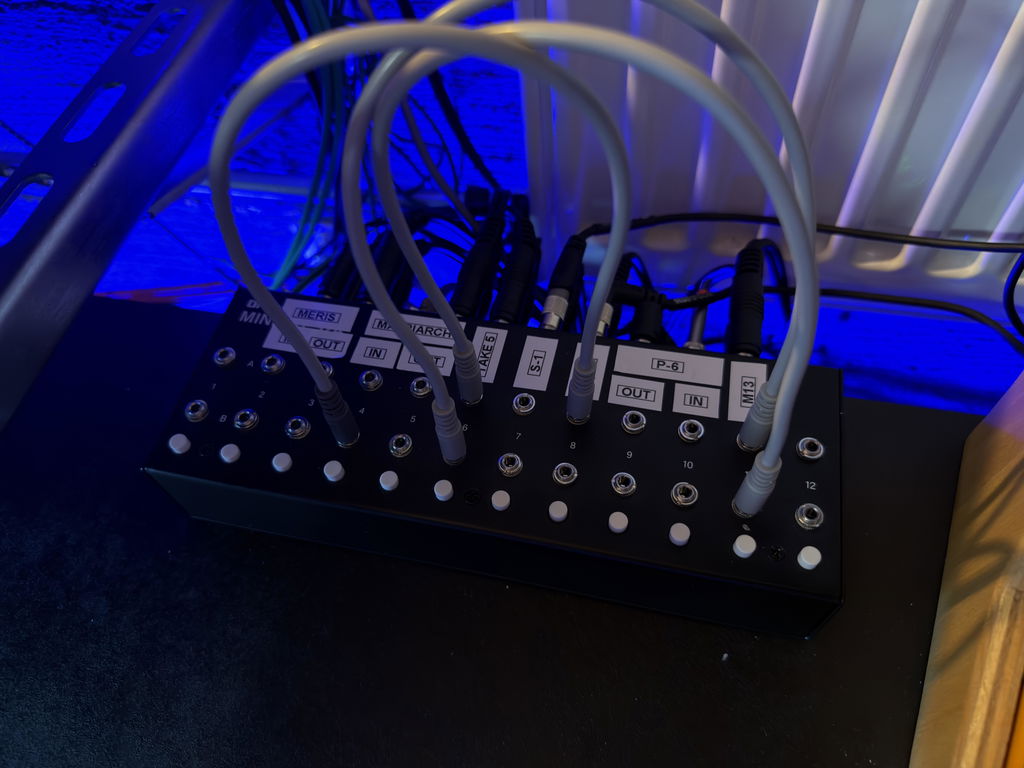
Unfortunately, one of the six included TRS cables is broken – of course, that's not Unz Unz's fault.
Compact and sturdy patchbay. It’s nice that the rear connections are easily accessible.

Two three-voice instruments from Sweden's Nyström Instruments, both built around touch and generative melody, and both a little different from anything else on your desk. The short answer: Crum Hum is the pure, immediate one: set it going and shape it with your fingertips. HUM 2 is the deeper one, with lockable sequencers, a separate engine per voice, six sensors and full studio connectivity. Here is the longer answer.
Crum Hum is a generative instrument first. Three touch-responsive voices run through one of twelve sound engines, and a Random control per voice decides how freely each line wanders. There are few menus and little to set up. You turn it on, pick a scale and play the triangular metal pads. It is built for ambient soundscapes and happy accidents.
HUM 2 takes the same idea much further. Each voice gets its own engine from a choice of 14, its own 64-step sequencer that can generate new phrases or lock a pattern into a loop, and its own Decay, Rand, Tone, Cut and Freq controls. On top of that come six sensors (distance, light, tilt X and Y, two touch pads), four assignable LFOs, 500 presets and a full set of CV, sync, MIDI and USB audio connections. It works as a standalone instrument, but it is also made to sit in a larger setup.


| Crum Hum | HUM 2 | |
|---|---|---|
| Voices | 3, touch controlled | 3, touch controlled, multitimbral |
| Sound engines | 12 | 14, selectable per voice |
| Sequencing | Generative and randomized melody and chord generation | Three 64-step sequencers, generative or locked loops, chords per voice |
| Scales | 12, including harmonic series, microtonal and unquantized | 17, including microtonal, overtone series, just intonation and free |
| Touch control | One triangular metal pad per voice | Three pads per voice: volume in the middle, pitch bend on the sides |
| Sensors | None | Distance, light, tilt X and Y, two extra touch pads, mappable to any knob |
| Modulation | 1 LFO | 4 assignable LFOs |
| Effects | Delay, reverb, overdrive | Delay, reverb, overdrive, with per-voice sends |
| Presets | No | 500 |
| CV and sync | 1 x CV out, clock in | 3 x CV out, 2 x CV in, sync in and out |
| MIDI and USB | MIDI in and out, USB MIDI | MIDI in and out (TRS), USB MIDI and USB audio |
| Availability | In stock, ships next working day | Pre-order, expected to ship in November 2026 |
| Price | 387 EUR | 675 EUR |
Yes, and they pair well. HUM 2's sync output can clock the Crum Hum's clock input, so the two stay in time while each generates its own lines. Put Crum Hum on drifting pads underneath and let HUM 2 play the melodies on top.
Still not sure? Email hey@unzunz.com and tell us what you want to make, and we will tell you which one fits. Both ship from Sweden.